


The World Radiocommunication Conference
The World Radiocommunication Conference (WRC), held every four years by the International Telecommunication Union (ITU), brings together the 194 ITU member states to review and revise the ITU’s Radio Regulations (ITU RR), an international treaty that sets rules to avoid harmful interference and foster global wireless technologies.
The next WRC is in Shanghai, China, beginning in October 2027. Among the key agenda items are new bands (in Agenda Item 1.7) for mobile wireless services, which should advance 6G wireless services across the globe.
Also, WRC-27 will look at new allocations to allow space-based “direct-to-device” (D2D) services (AI 1.13), as well as possible new or modified space research service allocations for communications in the lunar environment (AI 1.15). The AI 1.15 discussion supports the Working Families Tax Cut Act, which provides funding for the Artemis moon program and an eventual commercial Mars telecommunications orbiter.
Reflecting the emerging importance of space commercialization, a majority of the agenda items at WRC-27 will address satellite and other space-related spectrum issues.


The United States has officially launched its campaign to re-elect Doreen Bogdan-Martin as ITU Secretary-General. In addition, the U.S. is working to elect Jennifer Warren to the ITU Radio Regulations Board (RRB) and to re-elect the United States to the ITU Council. The campaign launch took place during the Inter-American Telecommunication Commission (CITEL) Assembly in San José, Costa Rica, March 16-19, 2026. These elections will take place during the ITU Plenipotentiary Conference in Doha, Qatar, in November 2026.
Strong U.S. leadership at the ITU helps foster innovation and economic growth through resilient and secure connectivity. As the world’s leader in telecommunication and information and communication technology, the United States proudly promotes exceptional leadership at the ITU.
Preparation for the quadrennial WRCs never ends. In the United States, the Federal Communications Commission (FCC) oversees an industry-led WRC Advisory Committee (WAC) that develops industry consensus on WRC agenda items. These industry views are reconciled with the federal positions developed by NTIA’s Interdepartment Radio Advisory Committee (IRAC). The United States then attempts to reconcile its unified positions with those of other countries in North America and South America through membership in the Inter-American Telecommunication Commission (CITEL) Permanent Consultative Committee II (PCC.II).
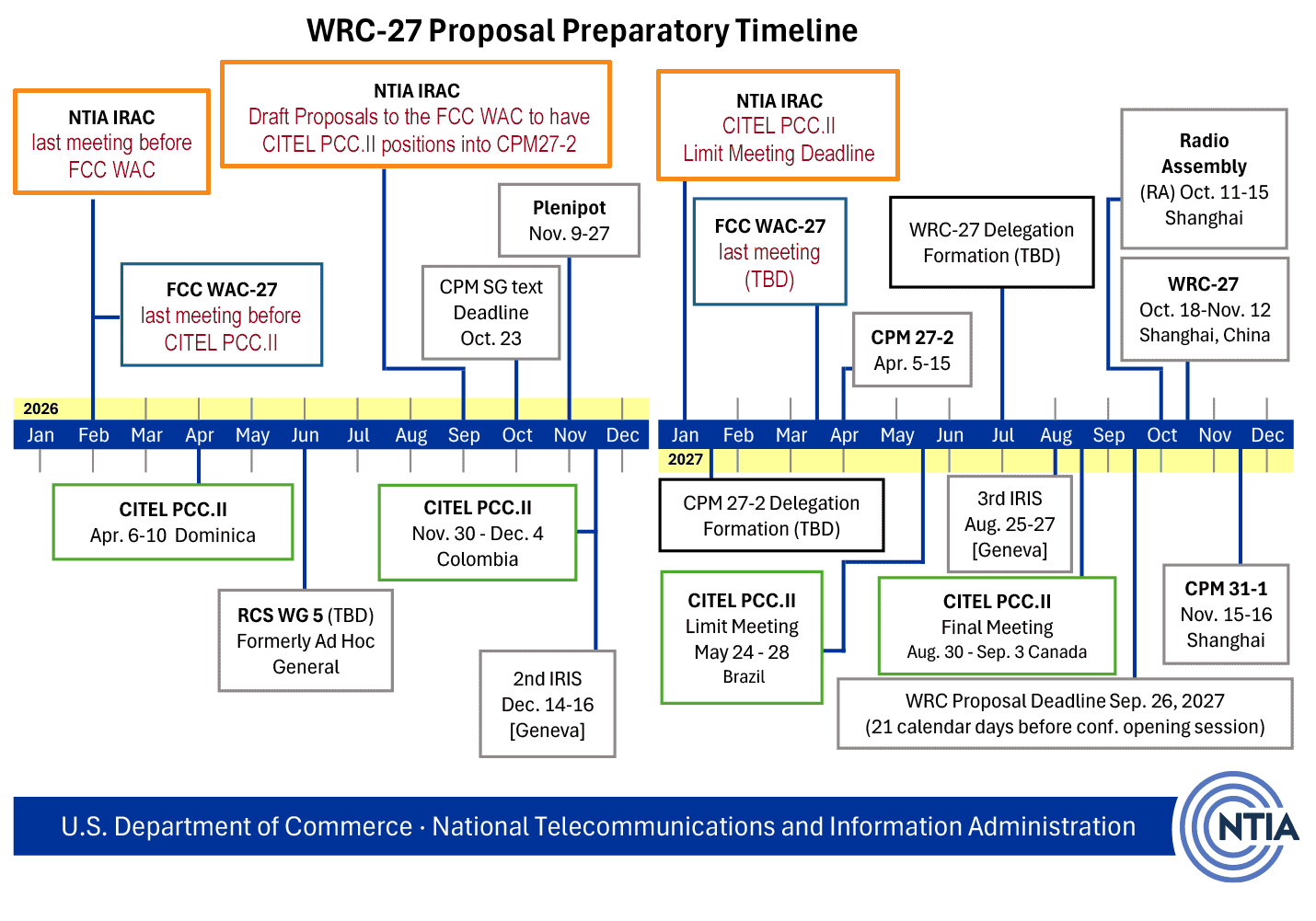
Coordinated U.S. contributions to PCC.II can be found on the FCC’s website at US contributions sent to CITEL PCC.II (for WRC-27) | Federal Communications Commission.
Agenda items at the upcoming WRC-27 are listed and described below:
| AI | NTIA Short Title | Description |
|---|---|---|
| 1.1 | Aeronautical and Maritime ESIMs at 50 GHz | to consider the technical and operational conditions for the use of the frequency bands 47.2-50.2 GHz and 50.4-51.4 GHz (Earth-to-space), or parts thereof, by aeronautical and maritime earth stations in motion communicating with space stations in the fixed-satellite service and develop regulatory measures, as appropriate, to facilitate the use of the frequency bands 47.2-50.2 GHz and 50.4-51.4 GHz (Earth-to-space), or parts thereof, by aeronautical and maritime earth stations in motion communicating with geostationary space stations and non-geostationary space stations in the fixed-satellite service, in accordance with Resolution 176 (Rev.WRC-23) |
| 1.2 | Smaller antenna sizes for FSS uplinks at 14 GHz | to consider possible revisions of sharing conditions in the frequency band 13.75-14 GHz to allow the use of uplink fixed-satellite service earth stations with smaller antenna sizes, in accordance with Resolution 129 (WRC-23) |
| 1.3 | Use of 50 GHz by gateway earth stations to NGSO FSS | to consider studies relating to the use of the frequency band 51.4-52.4 GHz to enable use by gateway earth stations transmitting to non-geostationary-satellite orbit systems in the fixed-satellite service (Earth-to-space), in accordance with Resolution 130 (WRC 23) |
| 1.4 | New FSS and BSS at 17 GHz | to consider a possible new primary allocation to the fixed-satellite service (space-to-Earth) in the frequency band 17.3-17.7 GHz and a possible new primary allocation to the broadcasting-satellite service (space-to-Earth) in the frequency band 17.3-17.8 GHz in Region 3, while ensuring the protection of existing primary allocations in the same and adjacent frequency bands, and to consider equivalent power flux-density limits to be applied in Regions 1 and 3 to non-geostationary-satellite systems in the fixed-satellite service (space-to-Earth) in the frequency band 17.3 17.7 GHz, in accordance with Resolution 726 (WRC 23) |
| 1.5 | Unauthorized operations of NGSO earth stations | to consider regulatory measures, and implementability thereof, to limit the unauthorized operations of non-geostationary-satellite orbit earth stations in the fixed-satellite and mobile-satellite services and associated issues related to the service area of non-geostationary- satellite orbit satellite systems in the fixed-satellite and mobile- satellite services, in accordance with Resolution 14 (WRC 23) |
| 1.6 | Equitable access for FSS for in 30-40-50 GHz | to consider technical and regulatory measures for fixed-satellite service satellite networks/systems in the frequency bands 37.5-42.5 GHz (space-to-Earth), 42.5-43.5 GHz (Earth-to-space), 47.2-50.2 GHz (Earth-to-space) and 50.4-51.4 GHz (Earth-to-space) for equitable access to these frequency bands, in accordance with Resolution 131 (WRC 23) |
| 1.7 | Terrestrial IMT | to consider studies on sharing and compatibility and develop technical conditions for the use of International Mobile Telecommunications (IMT) in the frequency bands 4 400-4 800 MHz, 7 125-8 400 MHz (or parts thereof), and 14.8-15.35 GHz taking into account existing primary services operating in these, and adjacent, frequency bands, in accordance with Resolution 256 (WRC-23) |
| 1.8 | Radiolocation above 231.5 GHz | to consider possible additional spectrum allocations to the radiolocation service on a primary basis in the frequency range 231.5-275 GHz and possible new identifications for radiolocation service applications in the frequency bands within the frequency range 275-700 GHz for millimetric and sub millimetric wave imaging systems, in accordance with Resolution 663 (Rev.WRC 23) |
| 1.9 | Appendix 26 aeronautical HF modernization | to consider appropriate regulatory actions to update Appendix 26 to the Radio Regulations in support of aeronautical mobile (OR) high frequency modernization, in accordance with Resolution 411 (WRC-23) |
| 1.10 | Article 21 pfd and eirp limits for FSS, MSS, and BSS at 70 and 80 GHz | to consider developing power flux density and equivalent isotropically radiated power limits for inclusion in Article 21 of the Radio Regulations for the fixed-satellite, mobile-satellite and broadcasting- satellite services to protect the fixed and mobile services in the frequency bands 71-76 GHz and 81-86 GHz, in accordance with Resolution 775 (Rev.WRC 23) |
| 1.11 | MSS space-to-space | to consider the technical and operational issues, and regulatory provisions, for space-to-space links among non-geostationary and geostationary satellites in the frequency bands 1 518-1 544 MHz, 1 545-1 559 MHz, 1 610-1 645.5 MHz, 1 646.5-1 660 MHz, 1 670-1 675 MHz and 2 483.5-2 500 MHz allocated to the mobile-satellite service, in accordance with Resolution 249 (Rev.WRC 23) |
| 1.12 | MSS for low-data-rate NGSO systems | to consider, based on the results of studies, possible allocations to the mobile satellite service and possible regulatory actions in the frequency bands 1 427-1 432 MHz (space-to-Earth), 1 645.5-1 646.5 MHz (space-to-Earth) (Earth-to-space), 1 880-1 920 MHz (space-to-Earth) (Earth-to-space) and 2 010-2 025 MHz (space-to-Earth) (Earth-to-space) required for the future development of low-data-rate non-geostationary mobile satellite systems, in accordance with Resolution 252 (WRC 23) |
| 1.13 | New allocations to MSS for IMT | to consider studies on possible new allocations to the mobile-satellite service for direct connectivity between space stations and International Mobile Telecommunications (IMT) user equipment to complement terrestrial IMT network coverage, in accordance with Resolution 253 (WRC-23) |
| 1.14 | Additional allocations to MSS | to consider possible additional allocations to the mobile-satellite service, in accordance with Resolution 254 (WRC 23) |
| 1.15 | Lunar Comms | to consider studies on frequency-related matters, including possible new or modified space research service (space-to-space) allocations, for future development of communications on the lunar surface and between lunar orbit and the lunar surface, in accordance with Resolution 680 (WRC 23) |
| 1.16 | Radio Quiet Zones | to consider studies on the technical and regulatory provisions necessary to protect radio astronomy operating in specific Radio Quiet Zones and, in frequency bands allocated to the radio astronomy service on a primary basis globally, from aggregate radio-frequency interference caused by non-geostationary-satellite orbit systems, in accordance with Resolution 681 (WRC-23) |
| 1.17 | Space Weather | to consider regulatory provisions for receive-only space weather sensors and their protection in the Radio Regulations, taking into account the results of ITU Radiocommunication Sector studies, in accordance with Resolution 682 (WRC-23) |
| 1.18 | Protection of EESS and RAS above 76 GHz | to consider, based on the results of ITU Radiocommunication Sector studies, possible regulatory measures regarding the protection of the Earth exploration-satellite service (passive) and the radio astronomy service in certain frequency bands above 76 GHz from unwanted emissions of active services, in accordance with Resolution 712 (WRC-23) |
| 1.19 | Primary EESS in 4 and 8 GHz | to consider possible primary allocations in all Regions to the Earth exploration-satellite service (passive) in the frequency bands 4 200-4 400 MHz and 8 400-8 500 MHz, in accordance with Resolution 674 (WRC-23) |
A preliminary agenda for the 2031 WRC was also determined in 2023 in Resolution 814. These items were discussed previously but did not make the final list for the WRC-27 agenda and may be considered for the agenda of a future WRC.:
| PAI | NTIA Short Title | Description |
|---|---|---|
| 2.1 | Extending frequency allocations to 325 GHz | to consider potential new allocations to the fixed, mobile, radiolocation, amateur, amateur-satellite, radio astronomy, Earth exploration-satellite (passive and active) and space research (passive) services in the frequency range 275-325 GHz in the Table of Frequency Allocations of the Radio Regulations, with the consequential update of Nos. 5.149, 5.340, 5.564A and 5.565, in accordance with Resolution 721 (WRC-23) |
| 2.2 | Possible frequencies for beam and non-beam WPT | to consider the possible [frequency bands] for [non-beam and beam] wireless power transmission to avoid harmful interference to the radiocommunication services caused by wireless power transmission, in accordance with Resolution 910 (WRC-23) |
| 2.3 | Aeronautical and maritime ESIMs at 13 GHz | to consider the use of aeronautical and maritime earth stations in motion communicating with non-geostationary space stations in the fixed-satellite service (Earth-to-space) in the frequency band 12.75-13.25 GHz, in accordance with Resolution 133 (WRC-23) |
| 2.4 | ISS allocations at 4 and 6 GHz for NGSO and GSO links | to consider, based on the results of ITU Radiocommunication Sector studies, support for inter-satellite service allocations in the frequency bands 3 700-4 200 MHz and 5 925-6 425 MHz, and associated regulatory provisions, to enable links between non-geostationary orbit satellites and geostationary orbit satellites, in accordance with Resolution 683 (WRC-23) |
| 2.5 | New AMS for use of IMT | to consider a possible primary allocation in the frequency bands [694-960 MHz, or parts thereof, in Region 1], 890-942 MHz, or parts thereof, in Region 2, and [3 400-3 700 MHz, or parts thereof, in Region 3] to the aeronautical mobile service for the use of International Mobile Telecommunications (IMT) user equipment in terrestrial IMT networks by non-safety applications, in accordance with Resolution 251 (Rev.WRC-23) |
| 2.6 | High-band IMT | to consider the identification of the frequency bands [102-109.5 GHz, 151.5-164 GHz, 167-174.8 GHz, 209-226 GHz and 252-275 GHz] for International Mobile Telecommunications, in accordance with Resolution 255 (WRC-23) |
| 2.7 | Improve maritime use of VHF bands | to consider improving the utilization of VHF maritime radiocommunication, in accordance with Resolution 363 (Rev.WRC-23) |
| 2.8 | Improve maritime use of MF and HF bands | to consider improving the utilization and channelization of maritime radiocommunication in the MF and HF bands, including potential revisions of Article 52 and Appendix 17, in accordance with Resolution 366 (WRC-23) |
| 2.9 | New RNSS at 5 GHz | to consider possible new allocations to the radionavigation-satellite service (space-toEarth) in the frequency bands [5 030-5 150 MHz and 5 150-5 250 MHz] or parts thereof, in accordance with Resolution 684 (WRC-23) |
| 2.10 | New EESS at 23 GHz | to consider a possible new primary allocation to the Earth exploration-satellite service (Earth-to-space) in the frequency band 22.55-23.15 GHz, in accordance with Resolution 664 (Rev.WRC-23) |
| 2.11 | EESS upgrade at 37 GHz or new EESS at 45 GHz | to consider an upgrade of the secondary allocation to the Earth exploration-satellite service (space-to-Earth) in the frequency band [37.5-40.5 GHz] or possible new worldwide frequency allocations on a primary basis to the Earth exploration-satellite service (space-to-Earth) in certain frequency bands within the frequency range [40.5-52.4 GHz], in accordance with Resolution 685 (WRC-23) |
| 2.12 | New allocations for EESS at 3 GHz | to consider possible new allocations to the Earth exploration-satellite service (active) in the frequency bands [3 000-3 100 MHz] and [3 300-3 400 MHz] on a secondary basis, in accordance with Resolution 686 (WRC-23) |
| 2.13 | Coexistence of EESS SARs and radiodetermination at 10 GHz | to consider studies on coexistence between spaceborne synthetic aperture radars operating in the Earth exploration-satellite service (active) and the radiodetermination service in the frequency band 9 200-10 400 MHz, with possible actions as appropriate, in accordance with Resolution 722 (WRC-23) |
| 2.14 | Review spectrum use of 470-694 MHz | to review spectrum use and needs of applications of broadcasting and mobile services and consider possible regulatory actions in the frequency band 470-694 MHz or parts thereof, in accordance with Resolution 235 (Rev.WRC-23) |