


Ensuring American Space Superiority
“Superiority in space is a measure of national vision and willpower, and the technologies Americans develop to achieve it contribute substantially to the Nation’s strength, security, and prosperity.”
– President Donald Trump, Executive Order on “Ensuring American Space Superiority,” Dec. 18, 2025
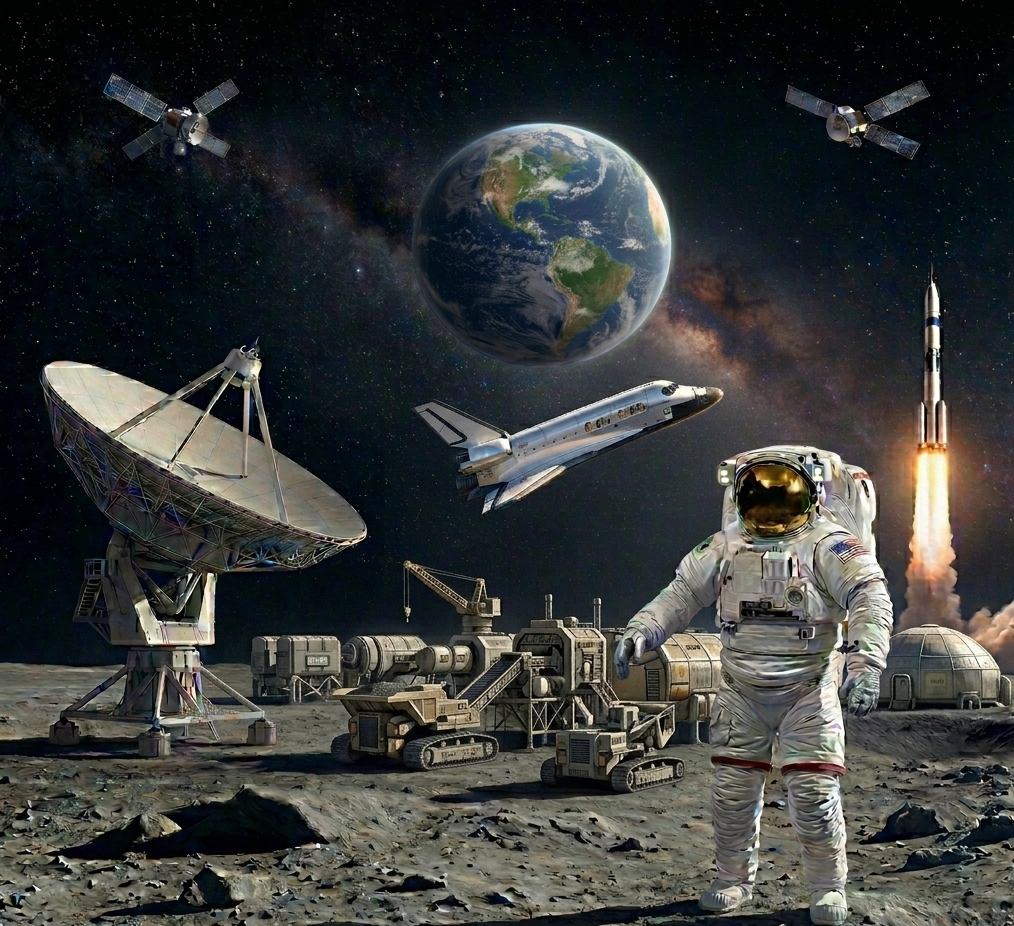
The United States is the global leader in space exploration and space commerce. Whether it’s extending the frontier of human activities in space or pioneering new satellite technologies, America leads the world in space innovation. Today, the United States is revolutionizing space-based technologies through a combination of private-sector entrepreneurship and government initiatives that maintain our nation’s space superiority.
In his executive order on space superiority, President Trump has called for “demonstrating spectrum leadership across space applications to promote United States technology competitiveness, spectrum management efficiency, and global market access.” NTIA is taking up this challenge alongside our colleagues in the Federal Communications Commission, NASA, NOAA and the other space-faring federal agencies.
Space Launch Frequency Coordination Portal
Spurring innovation in space technologies means lowering barriers to new satellite constellations and services. NTIA has debuted its Space Launch Frequency Coordination Portal, which will streamline federal reviews of spectrum requests by commercial space launch providers. The Portal replaced a system that was previously run largely through e-mail – which was no longer adequate to support the booming commercial space industry.
“Efficient, innovative spectrum management is essential to both our national security and economic prosperity. But for too long, the federal government has been bogged down by slow, outdated technologies,” said NTIA Administrator Arielle Roth. NTIA Administrator. Launch of the Portal “is the first step in the modernization of our systems that will position the United States for leadership in spectrum innovation and space for years to come.”
Sharing Spectrum with Commercial Space Operators

The United States has the most vibrant, innovative commercial space sector in the world. Two of the world’s three operating NGSO “mega-constellations” are based in the United States. According to the Satellite Industry Association, U.S. companies built 83 percent of the commercial satellites launched in 2024. The United States holds 69 percent of the global market share in satellite manufacturing and the 65 percent of the launch market share.
NTIA has a critical role in coordinating federal agencies and emerging space-based commercial operators. Our goal is to enable more efficient use of our spectrum resources while protecting the critical national security and public safety missions of the federal government. Recent successes include rapidly approving applications from new and innovative, low-Earth-orbit “mega-constellations” seeking to provide broadband and other services.
NTIA also manages the federal spectrum coordination of the space and ground stations for commercial space entities that file applications with the FCC. If you have questions regarding the status, please contact Robert Avery Jr. at [email protected].
Internationally, NTIA represents the Federal Government at the International Telecommunication Union (ITU), the United Nations agency where industry and government meet to consider the harmonization of spectrum in a technologically dynamic environment. Many of the issues facing the ITU at the 2027 World Radiocommunication Conference (WRC-27) involve the use of spectrum for space operations, including operations on and near the Moon.
WRC-27 also will debate creating new spectrum allocations for direct connectivity between satellites and mobile devices under agenda item 1.13. The United States is actively engaged in international discussions that will lead to successful outcomes on this agenda item.
NTIA approves federal agency requests for the use of frequencies to operate new space-based systems. Just as industry is deploying new and more technologically sophisticated and capable systems, so too are the federal agencies. NTIA helps those agencies find the necessary spectrum.
Going Back to the Moon
Federal spectrum is essential for the success of NASA's Artemis missions. It enables critical communications, tracking, navigation, and data transmission for the Artemis program by ensuring that radio waves for science data, voice communication, and spacecraft navigation do not suffer from interference with Earth-based systems.
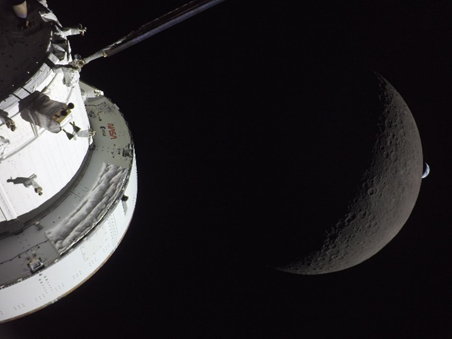
NTIA’s Institute for Telecommunications Sciences (ITS) lab has helped to power Americans’ historic return to the Moon, including by developing a model for understanding how communications signals travel on the Moon and between the Moon and spacecraft.
Expanding our reach into space requires communications on and around the lunar surface, and that begins with understanding how wireless signals behave in these environments. New radio-wave propagation models developed by NTIA and ITS predict how wireless signals behave as they move through space and around obstacles, allowing spectrum engineers to prevent interference and ensure communications signals reach their destination.
Our work has produced a first-of-its-kind model for the lunar surface. In September 2025, a new P-Series Recommendation was published by the ITU Radio Communication Sector. Recommendation ITU-R P.2170, Methods and models for predicting lunar radio-wave propagation characteristics, and the Irregular Lunar Model (ILM) is now available via NTIA’s GitHub repository.